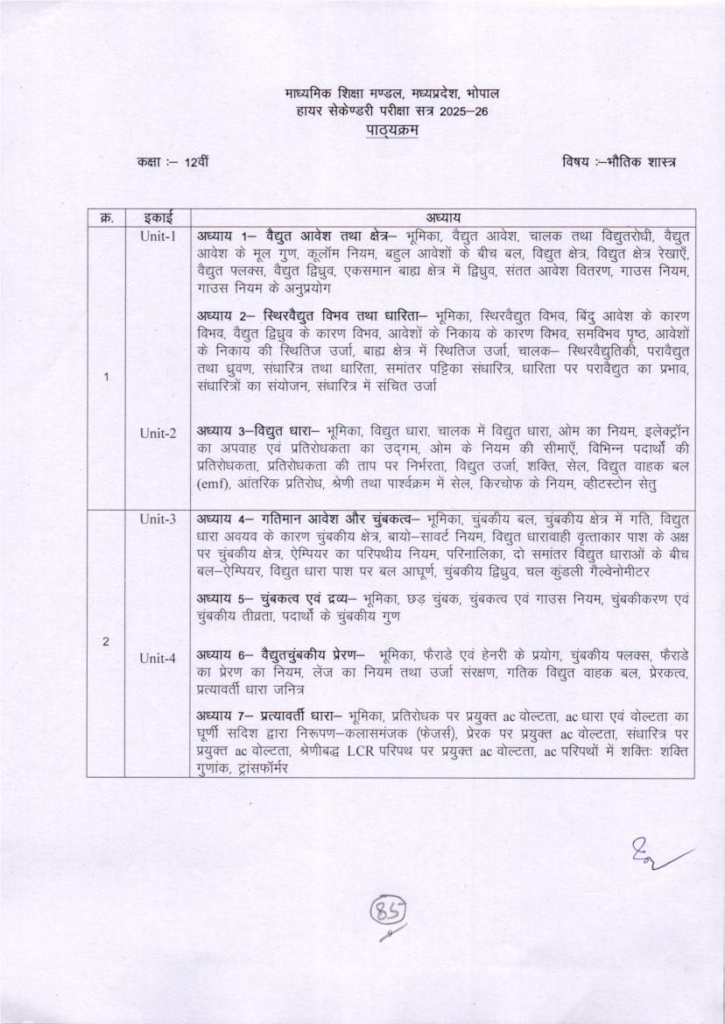
Board of Secondary Education, Madhya Pradesh, Bhopal
Higher Secondary Examination Session 2025-26
Syllabus Class: 12th
Subject: Physics
Unit-1
Chapter 1 – Electric Charge and Field – Role, Electric Charge, Conductor and Insulator, Electrolyte
Basic Properties of Charge, Coulog’s Law, Forces Between Multiple Charges, Electric Field, Electric Field Lines,
Electric Flux, Electric Dipole, Dipole in Uniform Wind Field, Continuous Charge Distribution, Gauss’s Law,
Applications of Gauss’s Law
Chapter 2 – Electrostatic Potential and Capacitance – Role, Electrostatic Potential, Causes of Point Charge
Potential, potential due to electric dipole, potential due to system of charges, equipotential surface, charges
Potential energy of the body, potential energy in the external field, conductor- electrolytic, dielectric
and the effect of dielectric on polarization, capacitor and capacitance, parallel plate capacitor, capacitance, capacitance,
A combination of transmitters, the energy stored in the capacitor.
Unit-2
Chapter 3 – Current – Role, Electric Current, Current in Conductor, Ohm’s Law, Electrons
The origin of runoff and resistivity, the limitations of Ohm’s law, of different substances
Resistivity, Resistivity Heat Dependence, Electrical Energy, Power, Cell, Conductive Force
(EMF), Internal Resistance, Cells in Range and Lateral Order, Kirchhoff’s Law, Wheatstone Bridge
Unit-3
Chapter 4- Moving Charge and Magnetism – Role, Magnetic Force, Motion in Magnetic Field, Electricity
Magnetic field due to current component, bio-savort rule, axis of electric current-carrying circular loop
At the magnetic field, Ampere’s law of circuitry, solenoids, between two parallel currents.
Force ampere, torque on electric current loop, magnetic bipolar, variable coil galvanometer
Chapter 5 – Magnetism and Matter – Role, Rods Magnets, Magnetism and Gauss’s Law, Magnetization and
Magnetic intensity, magnetic properties of substances
Chapter 6- Electromagnetic Induction – Introduction, Faraday and Henry’s Experiments, Magnetic Flux, Faraday
Unit-4
The law of induction, Lenz’s law and conservation of energy, kinetic electric force, and induction.
Alternating Current Generator
Chapter 7- Alternating Current – Role, AC Voltage Used on Resistor, AC Current and Voltage
Phasers represented by rotational vector, AC voltage used on inductors, capacitor
AC voltage used, AC voltage used on graded LCR circuits, power in AC circuits: Power
Coefficient, Transformer
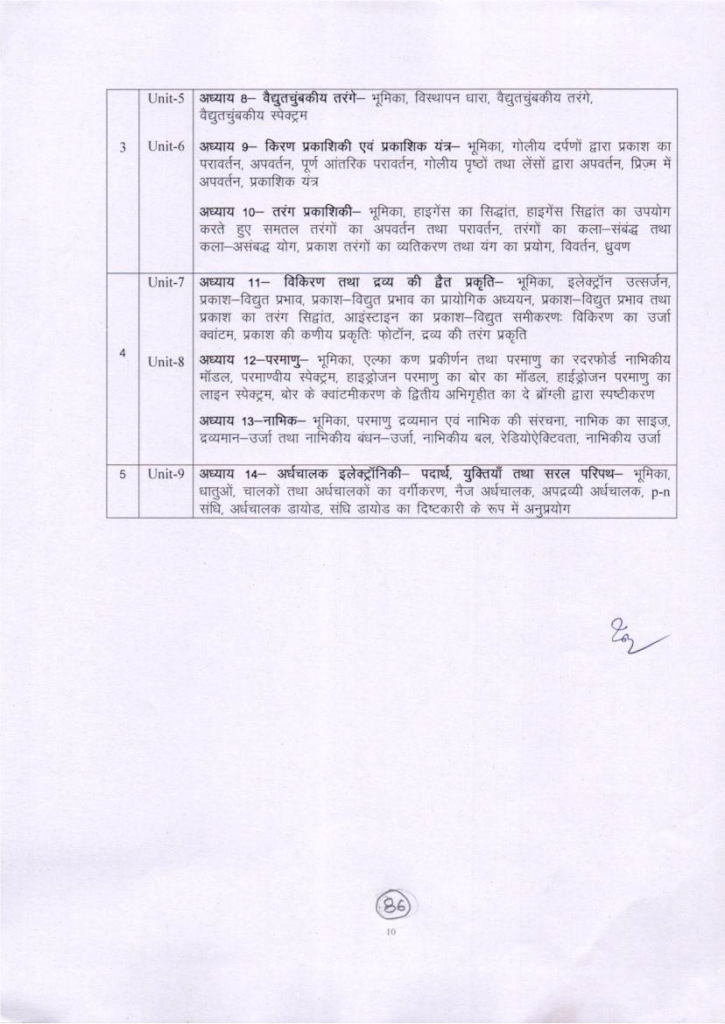
Unit-5
Chapter 8 – Electromagnetic Waves – Role, Displacement Current, Electromagnetic Waves,
Electromagnetic spectrum
Unit-6
Chapter 9 – Ray Optics and Optical Instruments – Role, Illumination by Spherical Mirrors
Reflection, refraction, complete internal reflection, refraction by spherical surfaces and lenses, in prisms
Refraction, optics
Chapter 10- Wave Optics – Role, Huygens’ Theory, Use of Huygens Theory
Refraction and reflection of plane waves, art-related of waves and
Art-unrelated yoga, interference of light waves and Young’s experiment, diffraction, polarization
Unit-7
Chapter 11 – Dual Nature of Radiation and Matter – Role, Electron Emission,
Photoelectric effect, experimental study of photoelectric effect, photoelectric effect and
Wave Theory of Light, Einstein’s Photoelectric Equation: The Energy of Radiation
Quantum, Particle Nature of Light: Photons, Wave Nature of Matter
Unit-8
Chapter 12 – Atom – Role, Alpha Particle Scattering and Rutherford Nuclear of Atoms
Model, atomic spectrum, Bohr’s model of hydrogen atom, hydrogen atom
The second assumption of the line spectrum, Bohr’s quantification, is explained by De Brongley.
Chapter 13 – Nucleus: Role, Atomic Mass and Structure of Nucleus, Size of Nucleus,
Mass-energy and nuclear bond-energy, nuclear force, radioactivity, nuclear energy
Unit-9
Chapter 14 – Semiconductor Electronics – Materials, Devices and Simple Circuits – Introduction,
Classification of Metals, Conductors and Semiconductors, Intrinsic Semiconductors, Non-Liquid