This post contains important questions from the Board of Secondary Education 2026 for Class 10 Science. These important questions have also been asked in previous years’ exams. At the end of this post, you will also be able to solve objective-type self-tests useful for the 2026 exam.
MP BOARD 2026 – Class 10 Science Important Questions and Answers
MP BOARD 2026- Objective Question Based Self Test – Science Class 10
Important Questions with Answers
Question 1 – What is corrosion? Explain with examples.
Answer: When a metal comes into contact with surrounding acids and moisture, it corrodes, and this process is called corrosion. For example, a black layer forms on silver and a green layer forms on copper.
Question 2 – Write the following word equation as a balanced chemical equation:
Zinc + sulfuric acid → Zinc sulfate + hydrogen
Answer: Balanced chemical equation:
Zn + H2 SO4 → ZnSO4 + H2
Question 3 – Explain the meaning of malleability and ductility.
Answer: Give marks for writing the meaning of malleability and ductility.
Question 4 – Name two metals that are found in the free state in nature.
Answer: Two metals found in the free state in nature are gold and platinum.
Question 5 – Write only one example each of saturated and unsaturated carbon compounds.
Answer – (i) An example of a saturated carbon compound is ethane (C₂H₃)
(ii) An example of an unsaturated carbon compound is ethene (C₂H₄)
Question 6 – Give only one example each of the functional group aldehyde and carboxylic acid.
Answer – (i) An example of a functional group aldehyde is propanal (C₂H₃CHO)
(ii) An example of a functional group carboxylic acid is propanoic acid (C₂H₃COOH)
Question 7 – Write only the chemical equation for the mechanism of photosynthesis.
Answer: Please write your own answers. (They will be uploaded to the site as soon as they become available.)
Question 8 – What is heterotrophic nutrition? Give an example.
Answer – When an organism consumes complex substances prepared by other organisms as food, it is called heterotrophic nutrition.
For example, heterotrophic nutrition is found in humans.
Question 9 – Define regeneration.
Answer – If simple organisms like Hydra and Planaria are cut into several pieces, each piece develops and forms a complete organism. This is called regeneration.
Question 10 – What is vegetative propagation?
Answer – There are many plants whose parts, such as roots, stems, and leaves, develop under suitable conditions and produce a new plant. Individual plants use this ability as a method of reproduction. This is called vegetative propagation.
Question 11 – What is the number of chromosomes in a human? What is the difference between the chromosomes of males and females?
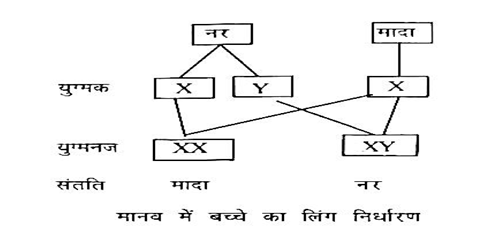
Answer – Humans have 23 pairs, or 46 chromosomes, of which 22 pairs are identical in males and females; they are called autosomes. The 23rd pair is different in males and females; they are called sex chromosomes. In females, these are denoted XX and in males, they are XY.
Question 12 – How did Mendel’s experiments reveal that different traits are inherited independently?
Answer – When Mendel crossed pea plants with two alleles, he obtained offspring plants with new combinations in the F-2 generation. The discovery of new traits different from the parents indicates that different traits are inherited independently.
Question 13 – What is a bi-convex lens?
Answer – A lens with both surfaces convex is called a bi-convex lens. The radii of curvature of these lenses can be the same or different.
Question 14 – Write any two applications of a concave mirror.
Answer – Two applications of a concave mirror are:
(i) Shaving
(ii) Medicine.
Question 15 – What happens when a light ray enters a rarer medium from a denser medium?
Answer – When a light ray enters a rarer medium from a denser medium, it deflects away from the normal due to refraction.
Question 16 – If an incident ray makes an angle of incidence of 30° on a plane mirror, what will be the value of the angle of reflection?
Answer – If an incident ray makes an angle of incidence of 30° on a plane mirror, the value of the angle of reflection will also be 30°. Because the value of the angle of reflection is always equal to the angle of incidence.
Question 17 – Define electric current. What is its SI unit?
Answer – The amount of charge flowing in a conducting wire in a unit time is called electric current.
Its SI unit is ampere.
Question 18 – Which two metal wires are most commonly used for electrical transmission?
Answer – Copper and aluminum wires are most commonly used for electrical transmission.
Question 19 – Define electromagnetic induction.
Answer – When a conductor is moving in a magnetic field or the magnetic field around a stationary conductor is changing, an induced electric current is generated in the conductor (coil). This phenomenon is called electromagnetic induction.
Question 20 – When does a short circuit occur in an electrical circuit?
Answer – When an energized wire and a neutral wire in a circuit come into contact, the current in the circuit becomes very high, then a short circuit occurs.
Question 21 – Why do two magnetic field lines never intersect?
Answer – Two magnetic field lines never intersect because two directions of magnetic field can never exist at a single point.
Question 22 – What is a device that converts mechanical energy into electrical energy called? What phenomenon is it based on?
Answer: A device that converts mechanical energy into electrical energy is called an electric generator. It is based on the phenomenon of electromagnetic induction.
Question 23 – Write only the names of the animals at different trophic levels in the food chain of an ecosystem.
Answer: The names of the animals at different trophic levels in the food chain of a grassland ecosystem are as follows:
(Grass → Grasshopper → Frog → Snake → Vulture)
Question 24 – What are omnivorous animals called?
Answer: Animals that obtain their food from both plant producers and carnivores are called omnivores.
Question 25 – Why should curd and sour substances not be stored in brass and copper vessels?
Answer: Metals (brass, copper) displace hydrogen atoms from acids in the form of hydrogen gas, which results in the formation of characteristic acidity, which changes the taste of curd and sour substances, hence these are not stored in brass or copper vessels.
Question 26 – When does acid rain occur? Write the causes and its effects.
Answer – When the pH value of rainwater falls below 5.6, it is acid rain, which is harmful to aquatic life.
Question 27 – Which acid is found in the following natural sources?
(i) Lemon
(ii) Ant sting
Answer – (i) Citric acid
(ii) Methanic acid
Question 28 – Write two uses of baking soda.
Answer – (i) In making baking powder
(ii) In leavening bread or cakes
(iii) As an antiseptic
(iv) As a fire extinguisher
(Write any two correct answers)
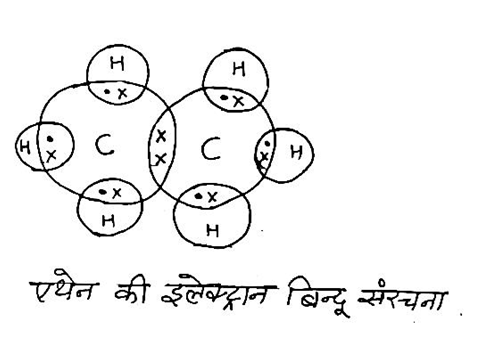
Question 29 – Draw the electron dot structure of ethane.
Answer –
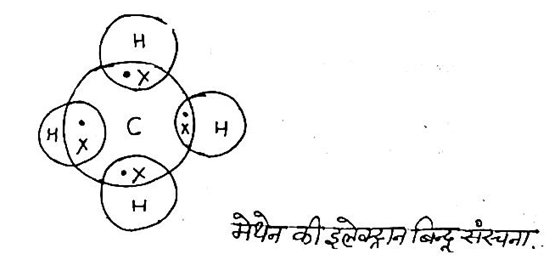
Question 30 – Draw the electron dot structure of methane.
Answer –
Question 31 – What is denatured alcohol? Write.
Answer – To identify alcohol, a dye is added to make it blue. This is called denatured alcohol.
Question 32 – How is alcohol used as a fuel? Write.
Answer – Ethanol is obtained by fermenting sugarcane juice. Many countries use this ethanol as a clean fuel by mixing it with petrol. This fuel produces only CO₂ and water when there is sufficient oxygen.
Question 33 – Define a biological process.
Answer – All processes that collectively perform maintenance functions are called biological processes. Maintenance processes are required to prevent damage and breakage.
Question 34 – Write the chemical reaction of photosynthesis.
Answer: Please write your own answers. (They will be uploaded to the site as soon as they become available.)
Question 35 – Why is vegetative propagation used to grow some plants? Write the reason.
Answer – Plants grown through vegetative propagation take less time to flower and fruit than those grown from seeds. Plants that have lost the ability to produce seeds can also be grown using this method.
Question 36 – Define tissue culture technique.
Answer – Tissue culture technique allows the production of multiple plants from a single plant under infection-free conditions. This technique is commonly used in the cultivation of ornamental plants.
Question 37 – How does the fetus receive nutrition within the mother’s body? Write.
Answer – The embryo receives nutrition from the mother’s blood; for this, there is a special structure called the placenta. It is a disc-like structure embedded in the uterine wall.
Question 38 – What is menstruation and approximately how many days does it last? Write.
Answer – The gradual breakdown of the egg wall and the expulsion of blood and mucus through the vagina is called menstruation. The duration of menstruation is approximately 2 to 8 days.
Question 39 – How is the sex of a child determined in humans? (Draw a diagram only)
Answer –
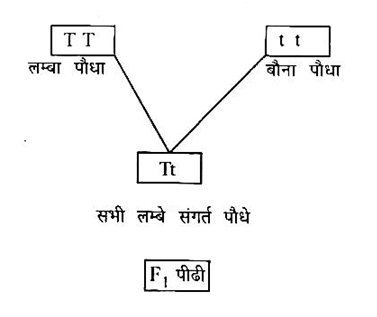
Question 40 – Draw a diagram of the first offspring generation (F₁) of inheritance.
Answer –
Question 41 – Write the laws of reflection of light.
Answer – (i) The angle of incidence is equal to the angle of reflection.
(ii) The incident ray, the normal to the mirror at the point of incidence, and the reflected ray all lie in the same plane.
Question 42 – Define the following:
(i) Center of curvature
(ii) Focal length
Answer – (i) Center of curvature: The reflecting surface of a spherical mirror is a part of a sphere. The center of this sphere is called the center of curvature of the spherical mirror.
(ii) Focal length: The distance between the pole and the principal focus of a spherical mirror is called the focal length.
Question 43 – The refractive index of diamond is 2.42. What does this statement mean? Write.
Answer – The refractive index of diamond is 2.42. This means that the ratio of the velocity of light in air to the velocity of light in diamond is 2.42.
Question 44 – Define the power of a lens of 1 diopter.
Answer: 1 diopter is the power of a lens with a focal length of 1 meter.
ID=1m-1
Question 45 – Why does the sky appear black to an astronaut instead of blue?
Give the reason.
Answer: The sky appears black to passengers flying at high altitudes because the scattering of light is not as pronounced at such heights. This is because the process of scattering occurs only in the Earth’s atmosphere.
Question 46 – Why do planets not twinkle? Give the reason.
Answer: Planets are much closer to Earth than stars, so they can be considered diffuse sources. If we consider a planet to be a collection of many point-sized light sources, the total change in the amount of light entering our eyes from all the light sources would be zero. Therefore, the effect of twinkling would be neutralized.
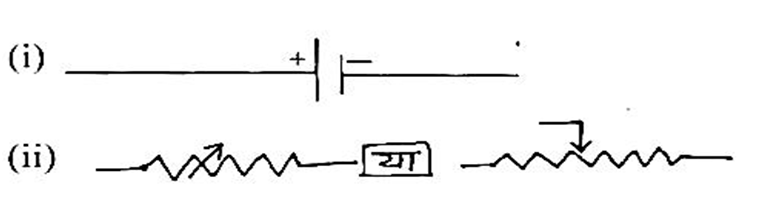
Question 47 – Draw symbols for the following components used in an electrical circuit:
Electric cell
Rheostat
Answer –
Question 48 – On what factors does the resistance of a conductor depend? (Write any two factors)
Answer – The resistance of a conductor depends on the following factors:
(i) The length of the conductor
(iii) The nature of the material
(ii) The area of its cross-section
Question 49 – What is a precipitation reaction? Write an example.
Answer – A reaction in which a precipitate is formed is called a precipitation reaction.
BaCl2 + K2SO4 → BaSO4 + 2KCl4
bariumchloride potassiumsulfate bariumsulfate potassiumchloride
Question 50 – Why are potato chip bags filled with nitrogen gas? Explain.
Answer: Potato chips (oil and fatty foods) react with oxygen in the air and become rancid. Nitrogen does not react easily at normal temperatures, so potato chip bags are filled with nitrogen gas. Removing oxygen from the chip bag and filling it with a less reactive gas like nitrogen is done to prevent rancidity.
Question 51 – Write any three functions of the human brain.
Answer: Functions of the Human Brain:
(1) The brain controls all voluntary actions of the body.
(2) The brain collects and stores information received from all sensory organs.
(3) The brain is responsible for body posture and balance.
(4) The brain also controls involuntary actions such as breathing and heartbeat.
(Any 3 or other options)
Question 52 – Name any three endocrine glands found in humans and the hormones secreted by them.
Answer: The three endocrine glands found in humans and the names of the hormones they secrete are as follows.
No. Endocrine Gland Secreted Hormone
- Pituitary Gland Growth Hormone
- Thyroid Gland Thyroxine Hormone
- Adrenal Gland Adrenaline Hormone
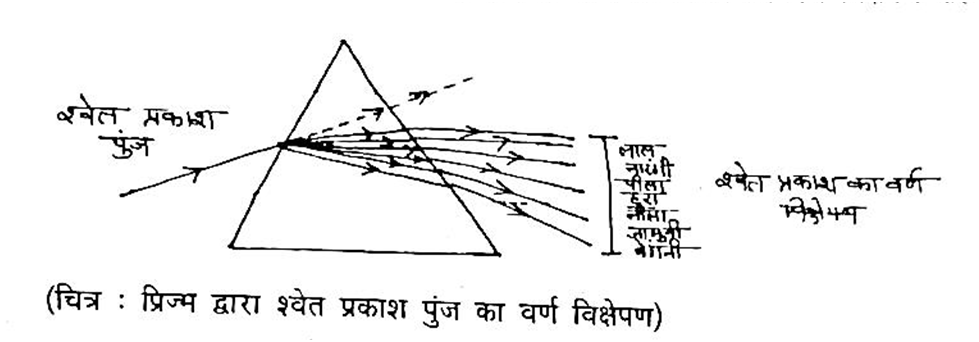
Question 53 – What is dispersion? Explain with a diagram.
Answer: The phenomenon of white light being split into its seven constituent colors is called dispersion.
Question 54 – Why does the clear sky appear blue?
Answer: When sunlight passes through the atmosphere in a clear sky, the tiny particles present in the air scatter blue more strongly than red, due to which the scattered blue light reaches our eyes, while the remaining colors are absorbed. Therefore, the clear sky appears blue.
Question 55 – Give an example of a metal that
is liquid at room temperature.
Can be easily cut with a knife.
It is the best conductor of heat.
Answer – (i) Mercury
(ii) Sodium
(iii) Silver and Copper
Question 56 – Define the following terms:
Mineral
Ore
Gangesite
Answer – (i) Mineral: Elements or compounds found naturally in the Earth’s crust are called minerals.
(ii) Ore: In some places, minerals contain significant amounts of a particular metal, making it easy and profitable to extract. These minerals are called ores.
(iii) Gangesite: Mineral ores from the Earth contain many impurities such as clay, sand, etc., which are called gangesite.
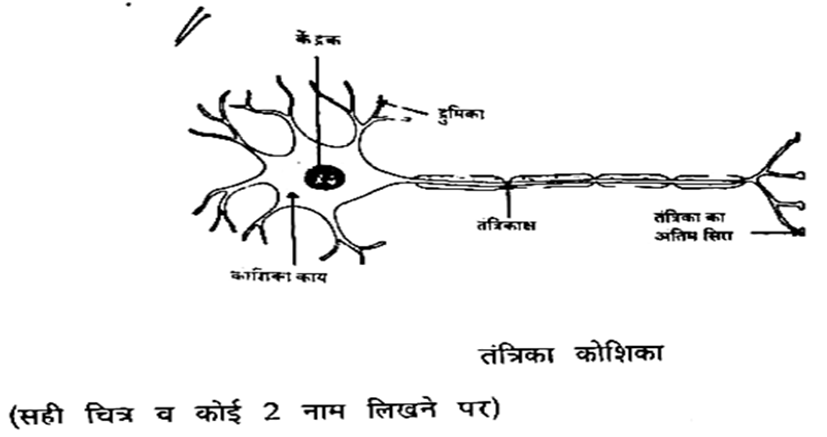
Question 57 – Draw a diagram of a nerve cell and name two organelles of a cell.
Answer –
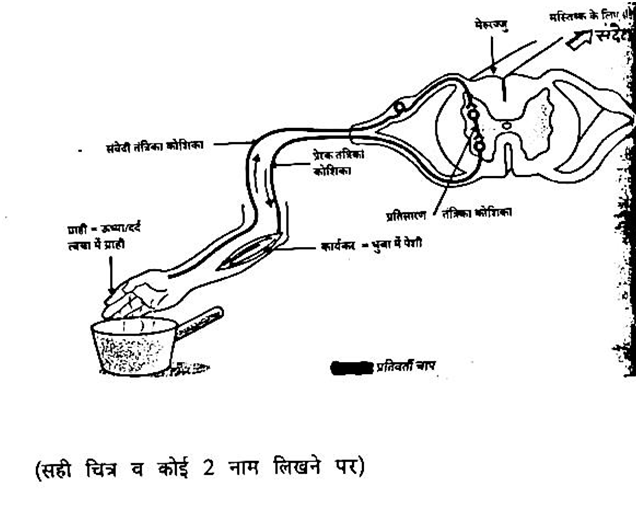
Question 58 – Draw a diagram of a reflex arc and name two organelles.
Answer –
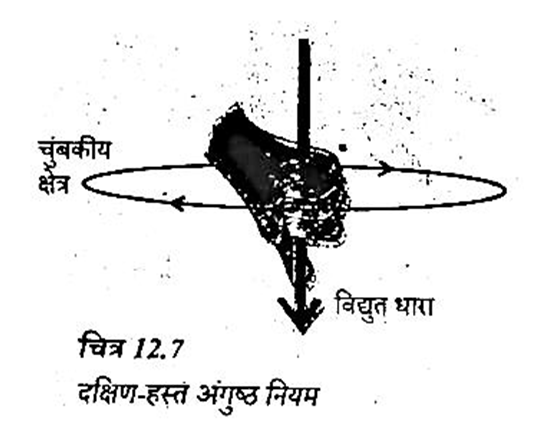
Question 59 – Write the right-hand thumb (Maxwell’s corkscrew) rule with a diagram.
Answer: If you are holding a current-carrying conductor in your right hand with your thumb pointing in the direction of the current, your fingers will wrap around the conductor in the direction of the magnetic field lines (as shown in the figure). This is called the right-hand thumb rule.
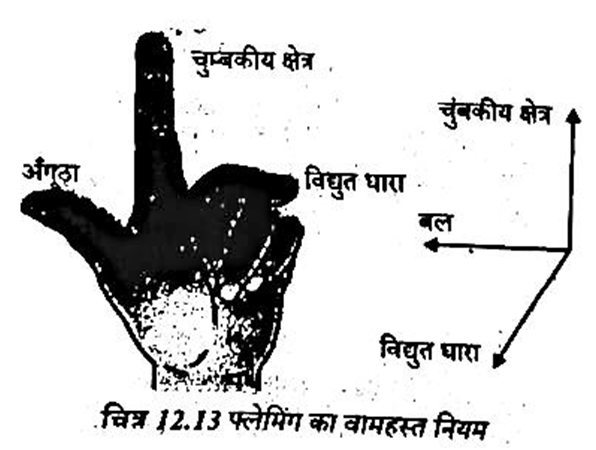
Question 60 – Write Fleming’s left-hand rule with a diagram.
Answer: According to this rule, spread the index finger, middle finger, and thumb of your left hand in such a way that they are perpendicular to each other. If the index finger points in the direction of the magnetic field and the middle finger points in the direction of the current flowing in the conductor, then the thumb will point in the direction of the conductor’s motion or the direction of the force applied on the conductor.
Question 61 – How does pH change cause tooth decay? How can it be prevented?
Answer – Tooth decay due to pH changes:
Tooth decay begins when the pH level in the mouth falls below 5.5. Tooth enamel is made of calcium hydroxy apatite (a crystalline form of calcium phosphate), which is the hardest substance in the body. It does not dissolve in water, but corrodes when the pH level in the mouth falls below 5.5. Oral bacteria produce acid by degrading sugars and food residues after eating. This can be prevented by rinsing the mouth after meals. Using an alkaline toothpaste can neutralize excess acid, thereby preventing tooth decay.
Question 62 – Write two uses for each of the following:
(i) Baking soda
(ii) Plaster of Paris
(iii) Bleaching powder
(iv) Washing soda
Answer – Write two uses for each of the following:
(i) Baking soda: 1. In the making of baking powder.
- In soda-acid fire extinguishers.
(ii) Bleaching powder: 1. For bleaching in the textile and paper industries.
- To disinfect drinking water.
(iii) Plaster of Paris: 1. In making toys, decorative items, etc.
- As a plaster for joining broken bones.
(iv) Washing soda: 1. In the glass, soap, and paper industries.
- Useful for household cleaning.
Question 63 – Write the names, molecular formula and structural formula of any four members of alkane homologous series.
Answer: Please write your own answers. (They will be uploaded to the site as soon as they become available.)
Question 64 – Define alkene and alkyne and write one example each.
Answer – (1) Alkenes: Hydrocarbons containing a double bond between carbon atoms and having the molecular formula (CnH2n) are called alkenes.
Examples:
(i) Ethene (CH2 = CH2)
(ii) Propyne (CH3 = CH2)
(2) Alkynes: Hydrocarbons containing a triple bond between carbon atoms and having the molecular formula (C2 H2n-2) are called alkenes.
Examples:
(i) Ethene (CH ≡ CH)
(ii) Propyne (CH3 = C ≡ CH)
Question 65 – Draw a neat and labeled diagram of the human digestive system.
Answer: Please write your own answers. (They will be uploaded to the site as soon as they become available.)
Question 66 – Draw a neat and labeled diagram of the human heart.
Answer: Please write your own answers. (They will be uploaded to the site as soon as they become available.)
Question 67 – Write the types of following chemical reactions:
2FeSO4(s)-heat → Fe2O3(s) + SO2(g) + SO3(g)
CaO(s)+H2O(l) → Ca(OH)2 (aq) + heat
Fe(s)+CuSO4(aq) → FeSO4(aq) + Cu(s)
Na2SO4(aq) + BaCl2(aq) → BaSO4(s) + 2NaCl(aq)
Answer – Types of reactions:
(i) decomposition reaction
(ii) Combination reaction
(iii) displacement reaction
(iv) Double displacement reaction
Question 68 – The reaction of sodium sulphate with barium chloride is what type of reaction? Write its equation.
Answer – (i) Barium chloride reaction of sodium sulphate is “double displacement” reaction. This is also called precipitation reaction.
Chemical equation:
Na2SO4(aq) + BaCl2(aq) → BaSO4(s) + 2NaCl(aq)
Question 69 – What product is formed when calcium oxide reacts with water?
Write the chemical equation for this reaction.
Answer: (ii) Calcium oxide reacts with water to form slaked lime (calcium hydroxide).
This is called a combination reaction.
CaO(s) + H2O(l) → Ca(OH)2 (aq) + heat
Question 70 – Draw a labeled diagram of an open and closed stomata.
Answer: Please write your own answers. (They will be uploaded to the site as soon as they become available.)
Question 71 – Draw a labeled diagram of the human excretory system.
Answer: Please write your own answers. (They will be uploaded to the site as soon as they become available.)
Question 72 – The radius of curvature of a convex mirror used for rear-view in an automobile is 3.00 m. If a bus is located 5.00 m from this mirror, determine the position, nature, and size of the image.
Answer – Solution- Radius of curvature, R = 3.00m
Image distance, u = -5.00.m Image distance, V =?
Image height, h’ =?
Focus distance, f = R⁄2 = +3.00m/2 = +1.5m
Because 1/V + 1/u = 1/f or 1/V + 1/f = 1/u
= +1/1.50 – 1/((-5.00) ) = 1/1.50 + 1/5.00
= (5.00 + 1.50)/7.50
V = (+7.50)/6.50 = +1.15m
The image is at a distance of 1.15 m behind the mirror.
Magnification, m = h’/h = V/u = 1.15m/(-5.00m)
= +0.23
The image is virtual, erect, and smaller than the object (0.23 times) in size.
Question 73 – A 4.0 cm object is placed 25.0 cm from a concave mirror with a focal length of 15.0 cm. At what distance from the mirror should a screen be placed to obtain a clear image? Determine the nature and size of the image.
Answer: Object size, h = +4.0 cm, object distance, µ = 25.0 cm, focal length, f = -15.0 cm, image distance, V=?
From the mirror formula 1/v + 1/μ + 1/f
or 1/v = 1/f + 1/μ = 1/(-15.0) – 1/(-25.0) = 1/15.0 + 1/25.0
or 1/v = (-5.0 + 3.0) / 75.0 = (-2.0) / 75.0 or V = -37.5 cm
The screen should be placed 37.5 cm in front of the mirror. The image is real.
Similarly, the magnification, m = h‘/h = V/u
or h‘ = μh/μ = ((-37.5 cm)(+4.0 cm)) / ((-25.0 cm))
The height of the image, h‘ = – 6.0 cm
The image is inverted and magnified.
You may also find this useful –
MP BOARD 2026- Objective Question Based Self Test – Science Class 10